
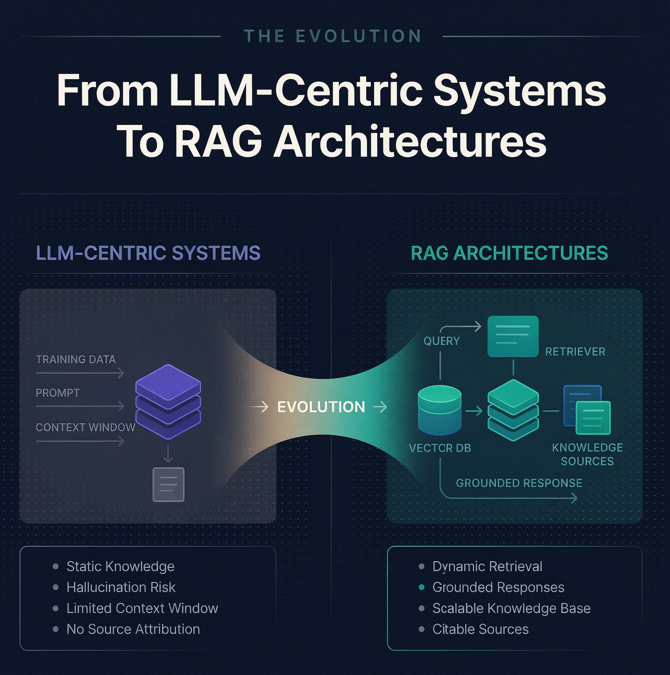
The Evolution from LLM-Centric Systems to RAG Architectures
-
The Core Problem: Why LLM-Only Approaches Break at Scale
Early AI platforms (including ESG research systems) were built using general-purpose LLM APIs such as GPT and Perplexity. These systems:
- Generated research queries
- Retrieved information via AI-powered search
- Produced summarised responses
- Extracted structured insights
- Generated final reports
This worked well for exploratory research and narrative outputs. However, as use cases scaled to institutional-grade analysis across hundreds of companies and filings, key limitations emerged:
Key Constraints of LLM-Centric Architectures
Retrieval and reasoning were coupled
LLMs performed search, selection, reasoning, and generation in a single step.
This created:
- No visibility into source selection
- No auditability
- Weak traceability of conclusions
Search became the bottleneck
LLM-powered search returns summaries, not full evidence:
- Critical disclosures often omitted
- Quantitative data lost
- Important context never retrieved
Structured extraction was inconsistent
Extracting:
- metrics
- policies
- targets
- governance structures
from conversational outputs led to:
- variability across runs
- poor reproducibility
- weak dataset quality
Document intelligence was fundamentally missing
Critical information lives inside:
- Annual reports
- Sustainability reports
- Regulatory filings
These contain:
- multi-column layouts
- financial tables
- footnotes and overrides
LLM search APIs are not designed to parse these structures reliably
-
The Architectural Shift: From LLMs → RAG
The breakthrough was not a better model—it was a better architecture.
New Workflow (RAG-Based)
Instead of:
“Ask model → get answer”
The system became:
Retrieve → Extract → Validate → Generate
What RAG Changes Fundamentally
Retrieval happens first
- Full evidence is captured before reasoning
- Eliminates hallucination from missing context
Evidence is complete, not summarised
- Direct access to filings and documents
- Richer context for downstream models
Responsibilities are separated. Each stage becomes independently optimisable:
- Retrieval
- Extraction
- Validation
- Generation
Outputs become auditable
- Every extracted value can be traced to source
- Enables institutional-grade confidence
-
The Hidden Truth: Model Choice Is Not the Main Driver
A critical insight from both documents:
Most failures come from parsing and retrieval—not model intelligence
Even top-tier models fail if:
- wrong section is retrieved
- tables are misparsed
- chunking is poor
So performance depends on four layers:
- PDF parsing / layout understanding
- Retrieval precision (RAG quality)
- Model reasoning
- Structured output discipline
-
Model Roles in a Modern RAG System
Rather than one “best” model, different models dominate different layers.
General LLMs (GPT-class)
Role: Reasoning + structured output
Strengths:
- Highest financial reasoning accuracy (~88–90%)
- Strong table/JSON generation
- Consistent outputs
Weakness:
- Dependent on upstream retrieval quality
Best use:
- Normalisation
- multi-year alignment
- final table generation
Claude (Anthropic)
Role: Long-context reasoning + document interpretation
Strengths:
- Handles large documents
- Strong multi-step extraction
- Excellent contextual understanding
Weakness:
- Slightly weaker numerical precision
Best use:
- filings ingestion
- complex disclosures
- cross-document synthesis
Gemini (Google)
Role: Document parsing and extraction
Strengths:
- Best-in-class PDF + layout understanding
- Strong OCR and table reconstruction
- Top performance in document extraction benchmarks
Weakness:
- Less consistent reasoning
- weaker structured outputs without control
Best use:
- extracting tables from filings
- parsing complex layouts
Perplexity
Role: Retrieval assistant
Strengths:
- fast retrieval
- citation support
Weakness:
- not designed for structured extraction
- inconsistent outputs
Best use:
- ad hoc research queries
Not suitable for:
- production data pipelines
-
The Real Architecture: How Best-in-Class Systems Work
Optimal Pipeline
- Document ingestion
- PDF → layout-aware parser (Gemini / DocAI)
- Data separation
- Extract tables and text independently
- Storage
- structured JSON + indexed chunks
- Retrieval (RAG)
- vector database / semantic search
- Reasoning layer
- GPT or Claude:
- align years
- normalise metrics
- resolve inconsistencies
- GPT or Claude:
- Validation layer
- cross-check against source
- Output generation
- structured tables + narrative
-
Why Hybrid Systems Win
A key synthesis across both documents:
“No single model wins end-to-end”
- Gemini → best extraction (front-end)
- GPT / Claude → best reasoning + structuring (back-end)
Another critical insight:
- Vision/document models → best at structure
- LLMs → best at meaning
So:
Best performance = hybrid system combining both
-
Why Financial Data & Documents Are Hard
Both perspectives converge on this:
Financial filings are adversarial to AI systems because they include:
- inconsistent naming conventions
- multi-column formatting
- nested tables
- footnotes that override numbers
- mixed narrative + quantitative content
This is why:
- extraction is difficult
- consistency is hard
- deterministic outputs require careful design
-
Final Synthesis
What changed?
The evolution was not:
“better models”
It was:
from monolithic AI → modular AI systems
What matters most now
- Retrieval quality > model choice
- Parsing accuracy > reasoning accuracy
- Architecture > prompt engineering
Best-in-class setup today
- Parsing: Gemini / DocAI
- Retrieval: RAG (vector DB)
- Reasoning: GPT or Claude
- Validation: independent layer
- Output: structured + traceable
Bottom line
- LLMs alone are sufficient for exploration
- RAG systems are required for production
- Hybrid architectures are required for accuracy at scale